

From Insight to Belief
A transpersonal, capacity-based framework for “mystical meaning” in psychedelic experience
The issue is not what experiences mean, but how we relate to the meaning that emerges.
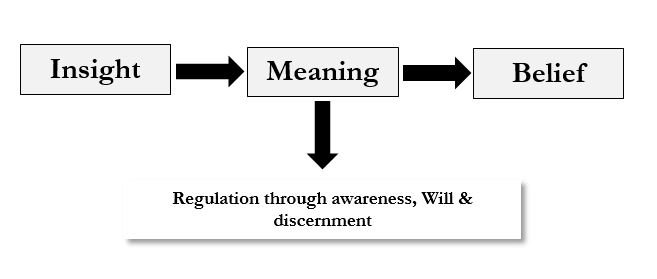

When Insight Feels Like Truth
Psychedelic experiences can generate profound insight, often accompanied by a heightened sense of certainty or “felt truth.” While such experiences may catalyse meaningful psychological and existential transformation, they may also increase the likelihood that interpretation rapidly stabilises as belief.
This challenge becomes particularly significant in mystical or metaphysical experiences, where meanings may feel deeply self-evident while remaining difficult to verify or falsify. At the same time, such meanings do not emerge in isolation, but are shaped through relational, cultural, and psychological contexts.
This raises an important ethical and clinical question: how can psychedelic care engage experiences that are phenomenologically spiritual without either reducing them to pathology or prematurely consolidating them into metaphysical belief?
Recent models such as REBUS and FIBUS suggest that psychedelic states may simultaneously increase the generation of insight while reducing epistemic constraint, creating conditions in which compelling but misleading beliefs may emerge. Contemporary work on intersubjective mediation further highlights the role of therapeutic, relational, and cultural frameworks in shaping how experience becomes interpreted and stabilised as meaning.
However, while these approaches illuminate the external and relational conditions under which meaning is formed, less attention has been given to the intrapsychic capacities required to relate to meaning once it arises — particularly under conditions of heightened certainty.
The Central Question
How do we relate to meaning that feels unquestionably true, yet remains epistemically uncertain?
This framework proposes that the central challenge of psychedelic integration lies not only in the content of experience, nor solely in its interpretation, but in the regulation of one’s relationship to meaning itself.
Rather than asking only:
“What does this experience mean?”
the framework introduces an additional question:
“How is meaning being formed, held, evaluated, and integrated over time?”

Relational Dimensions of Integration
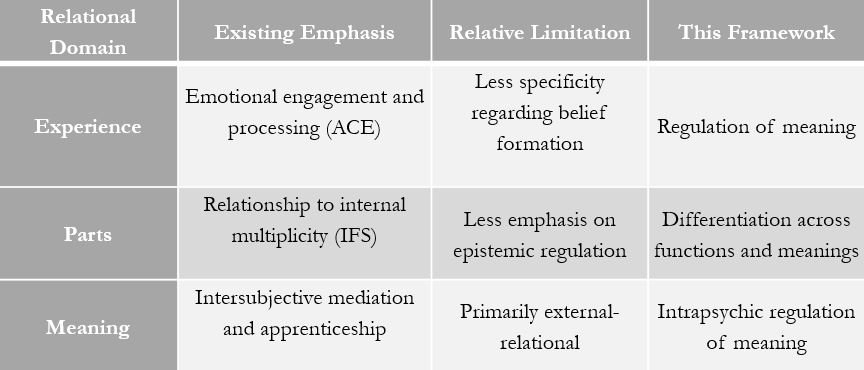
Contemporary approaches increasingly recognise that transformation depends not only on what is experienced, but on how individuals relate to that experience.
Models such as ACE emphasise emotional engagement, openness, and psychological flexibility, while parts-based approaches such as IFS highlight the relationship between the individual and different aspects of the self. Intersubjective approaches further emphasise the relational and cultural mediation of meaning within psychedelic contexts.
This framework builds on these approaches while proposing a further dimension: the regulation of the relationship to meaning itself.
A Capacity Based Framework
Drawing on Psychosynthesis psychology, this framework proposes that psychological capacities such as awareness, discernment, and will play a central role in regulating the transition from insight to belief.
Within Psychosynthesis, the “I” is understood not only as an observing centre of awareness, but as “a centre of awareness and Will” capable of relating to experience intentionally rather than reactively.
From this perspective, awareness alone may be insufficient under conditions of heightened certainty. What is additionally required is the capacity to regulate how meaning is taken up.
Will introduces processes of evaluation, deliberation, discernment, and temporal spacing, allowing insight to be held provisionally rather than immediately stabilised as belief.
The contribution of this framework is not to determine the truth of insight, but to regulate the conditions under which meaning becomes belief.

The “I” and Interfaith Relevance
A central feature of Psychosynthesis is the distinction between the contents of consciousness and the “I,” understood as a content-independent centre of awareness and Will.
Through the complementary processes of “identification” and “disidentification”, individuals are able both to participate in experience and to maintain differentiation from it. In this sense, identification enables engagement, while disidentification enables perspective and regulation.
Importantly, this capacity is not dependent upon adherence to any particular metaphysical framework. While Psychosynthesis includes transpersonal dimensions, engagement with the “I” does not require commitment to specific ontological beliefs.
This allows the framework to operate across differing existential, secular, and interfaith contexts, supporting openness to meaning without requiring premature closure regarding its ultimate truth-status.
In this sense, the framework proposes a potential middle path between reductive dismissal of mystical experience and premature metaphysical consolidation.
Psychological Functions & “Felt Truth”
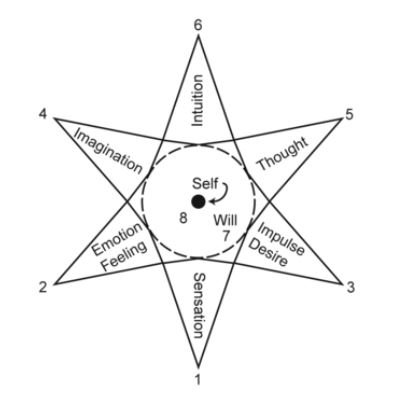
Psychedelic states may involve the simultaneous activation of multiple psychological functions, including affective, imaginal, intuitive, somatic, and cognitive processes.
Under conditions of reduced top-down constraint, these functions may become mutually reinforcing, contributing to the coherence and conviction with which meaning is experienced.
Meaning is therefore not only generated, but often experienced as self-evident.
At the same time, these processes do not necessarily privilege accuracy. Different psychological functions may generate partial, symbolic, emotionally charged, or conflicting forms of meaning.
This framework proposes that the capacity to differentiate between these functions — while remaining in relationship to them — becomes particularly important in contexts where insight rapidly stabilises as belief.
(Below is Assagioli’s “Star Diagram” depicting the various psychological functions defined in Psychosynthesis, and their co-ordination via the Will.)
The Stages of Will
Within this framework, the stages of will introduce temporal and epistemic spacing into meaning formation.
Rather than immediately consolidating insight as belief, meaning is gradually related to through processes of:
Evaluation - how is meaning being formed?
Deliberation - what else could it mean?
Choice - how do I relate to it?
Affirmation - can I hold that stance?
Exploration - what happens in reality?
Integration - what becomes lived?
These stages support a more reflective relationship to meaning, allowing insight to be evaluated, explored, and integrated over time rather than prematurely stabilised through certainty or identification.
Example
“I should leave my profession to pursue a spiritual or healing path.”
Within this framework, such a meaning is neither dismissed nor treated as immediately authoritative.
Instead, it is gradually related to through processes of evaluation, deliberation, exploratory action, and integration over time.
Action is not avoided, but re-sequenced: behavioural engagement occurs within exploration, while identity-level commitment is deferred until meaning has been sufficiently evaluated across contexts and time.
For example, the Evaluation stage may involve exploring what makes the idea feel compelling or certain, which motivations, psychological functions, and internal “parts” are most activated, whether the meaning carries a sense of urgency or absoluteness, and whether it is being interpreted literally or symbolically.
The Deliberation stage may involve considering alternative interpretations, differentiating between possibilities, and developing the capacity to tolerate ambiguity without prematurely resolving meaning into belief or action.
Subsequent stages (choice, affirmation, exploration, integration) involve consciously determining how to relate to the meaning, exploring it through lived experience, and gradually integrating it over time.
The same process may also apply to more explicitly epistemic or metaphysical shifts — for example, transitions from atheistic to animistic belief following perceived encounters with consciousness in nature.
Development of Capacity Over Time
From this perspective, the capacities involved in regulating meaning formation are not developed solely during integration, but across the broader temporal arc of psychedelic work, including preparation, experience, and post-session reflection.
This may involve:
cultivating awareness of internal multiplicity
developing the capacity for disidentification
strengthening discernment
and learning to relate to meaning without premature foreclosure
These capacities are relevant across both clinical and non-clinical contexts, although their development may require differing degrees of relational support depending on baseline psychological structure and stability.
The framework therefore positions integration not as a single post-experience process, but as an ongoing developmental cultivation of psychological capacity over time.
Trait Level Change
This perspective also has implications for how psychedelic experiences become stabilised as enduring patterns of thought, behaviour, and identity.
Long-term change may depend not only on the intensity or content of experience, but on the individual’s capacity to relate to emerging meaning reflectively over time.
From this perspective, Will supports the gradual integration of insight into lived experience, allowing transformation to unfold in a more sustainable and adaptive manner rather than through immediate or unexamined belief formation.
Ongoing Exploration
This framework is currently being developed through ongoing writing, conference presentations, and future dialogues exploring mystical meaning, belief formation, and psychological capacity in psychedelic experience.
If you would like to receive updates regarding future talks or publications, you can register your interest below. A webinar on the topic is planned for Q4 2026.
If you are interested in related conversations, collaborations, or further discussion of the work, you are also welcome to get in touch.
This work sits at the intersection of Psychosynthesis, psychedelic integration, and the psychology of meaning-making.
You can also explore: